

Vedic, Western, numerology, astrocartography and human design from one REST API. NASA JPL precision, 48 ayanamsas from Lahiri to Surya Siddhanta, a 62 ms median response, and one credit a call however much you ask for.
- 299
- Vedic, Western, numerology, more
- 330
- Named calculations, one credit a call
- 62 ms
- Median server time · 76% under 100 ms
- 48
- Ayanamsas, classical and modern
Every request and response below is copied from the shipped catalogue, which is generated by calling the live server. Paste the curl and you get the JSON on the right.
{
  "date_time": "2026-09-01T06:00:00+05:30",
  "timezone_as_float": 5.5,
  "latitude": 26.9124,
  "longitude": 75.7873
}{
"data": {
"sunrise": "2026-09-01T06:09:56+05:30",
"sunset": "2026-09-01T18:43:30+05:30",
"day_length_seconds": 45214.0
},
"status": 200,
"is_error": false
}Hindu rising convention, so it agrees with the panchanga day to the second.
One JSON envelope on every route. Failed requests are never charged. Errors carry a stable machine code, not prose that changes between releases.
Or skip the curl entirely
TypeScriptThe official SDK types all 299 endpoints and every field they take, with the documentation on hover. Zero dependencies.
npm install occult-apiFast where it matters, and honest about the rest
Median response is 62 ms of server time and 76% of endpoints answer in under 100 ms, measured across every published example rather than a cherry-picked one. A handful of deep scans — a full varshaphal sweep, a year of raasi dasha — take seconds, and they are documented as such. You will know what you are getting before you integrate, not after.
Classical and modern, side by side
Positions come from NASA JPL ephemeris data with the full 105 MB data set and 735 fixed stars, tested from 500 to 2999 AD. Where competitors ship Lahiri and stop, this exposes 48 ayanamsas — including the Surya Siddhanta family, true Citra, true Revati and true Pushya — so you can give your users the exact tradition they ask for instead of the one that was convenient to implement.
Built for the MCP era
A published Model Context Protocol server means an AI assistant can search the whole surface, read the request schema and make a call, without you writing a tool wrapper per endpoint. Five tools cover every endpoint; searching and reading the docs cost nothing, so an agent can explore the API before it spends a credit.
One API instead of five
Deep Jyotisha — divisional charts, ashtakavarga, dasha systems, panchanga, muhurta, upagrahas — alongside Western natal work, numerology in four systems, astrocartography, human design, eclipses and mundane transits. One authentication scheme, one response envelope, one bill.
Vedic depth
- Divisional charts D2–D60, each on its own route
- Ashtakavarga: sarva, bhinna and the pindas
- Panchang, muhurta, choghadiya, hora, vrat and festivals
- Dashas, tarabala, chandrabala, upagrahas
Global systems
- Western natal charts, planets and house cusps
- Numerology in Vedic, Chaldean, Pythagorean and Chinese
- Astrocartography lines, parans and relocation
- Human design charts, properties and connections
Mundane & events
- Solar and lunar eclipses, local circumstances
- Ingresses, stations and lunations
- Global transit events
- Regional calendars: Tamil, Bengali, Telugu, Malayalam, Nepali
Developer surface
- One JSON envelope on every route
- A runnable request body on every endpoint
- Interactive playground — send a real request in the browser
- MCP server on npm for AI agents
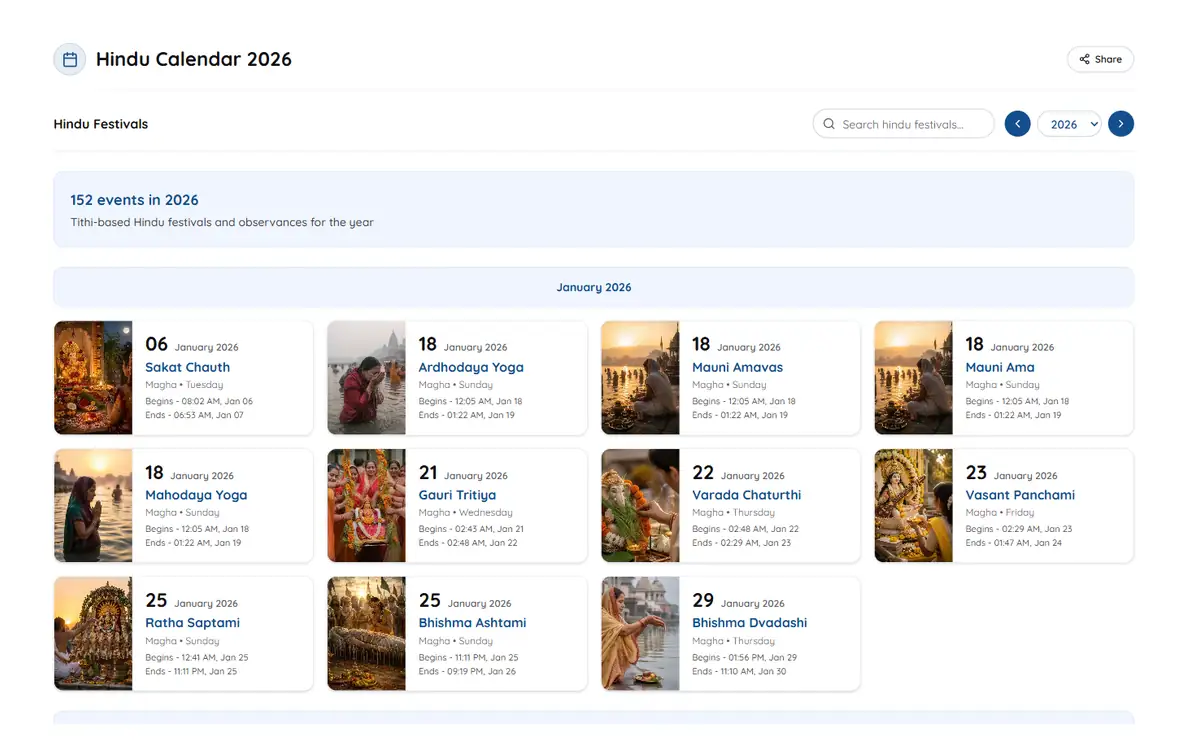
Screens built on these endpoints. Every one is a live interface running against the same API you would be calling — the endpoint that produces each is named beneath it.
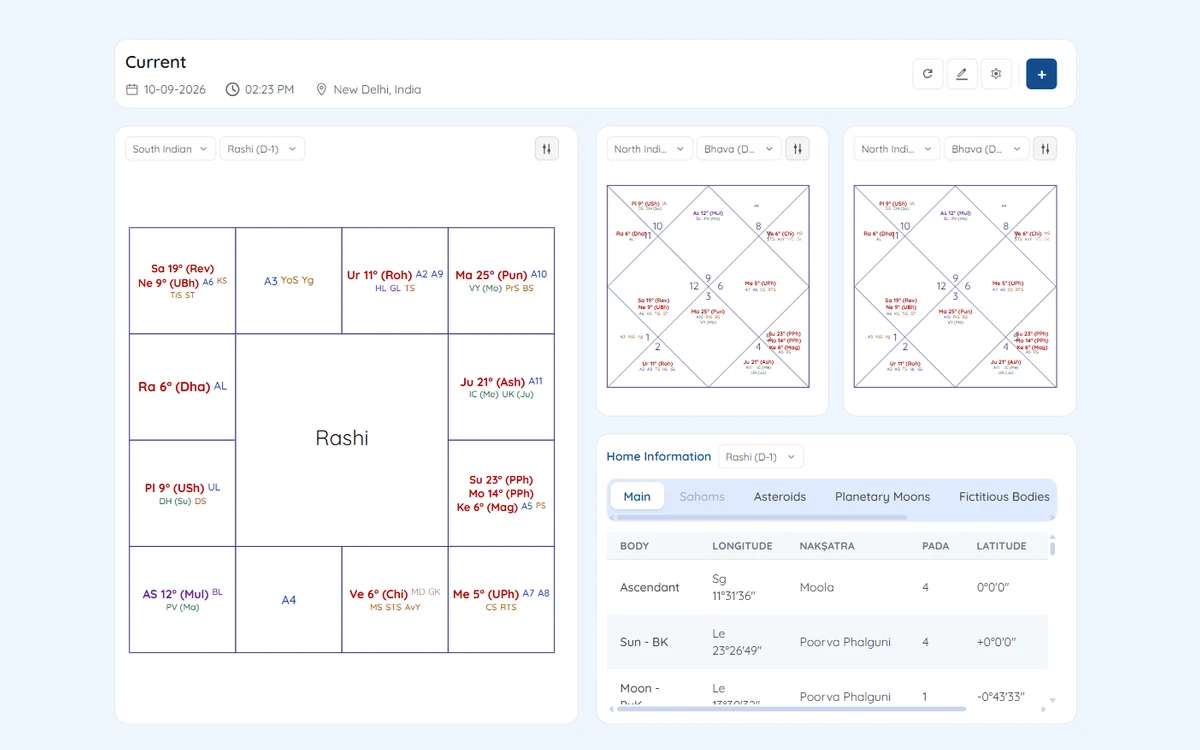
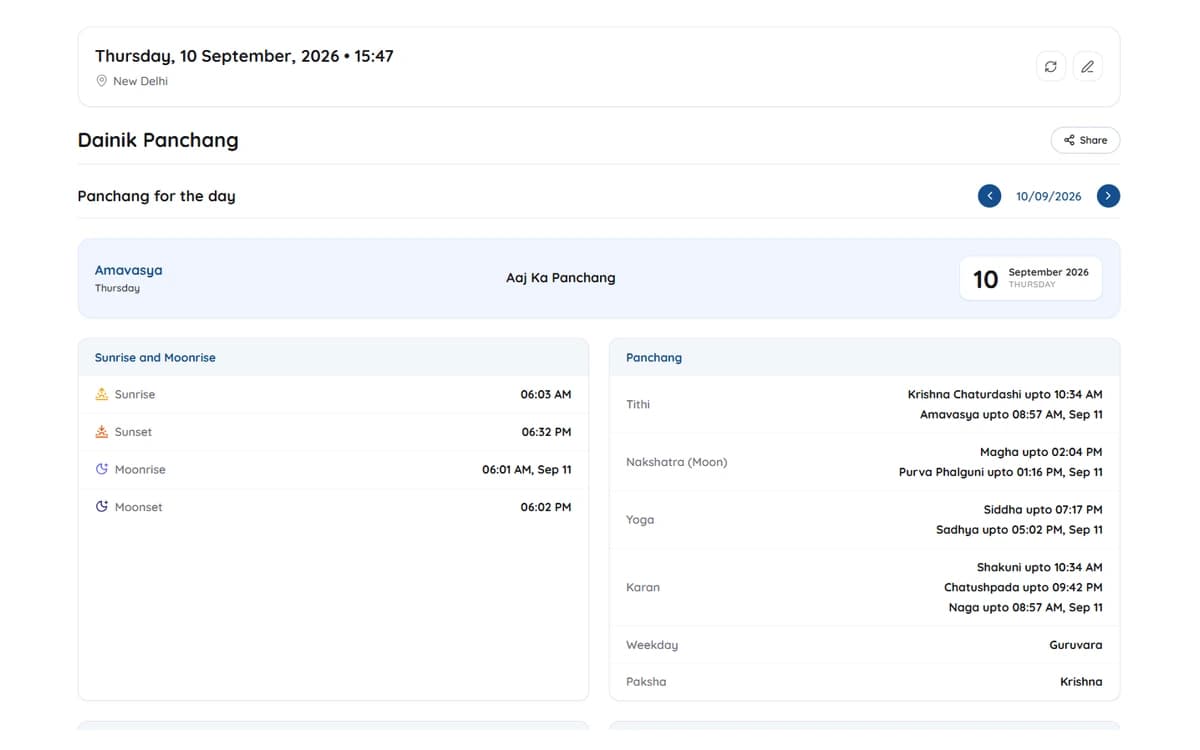
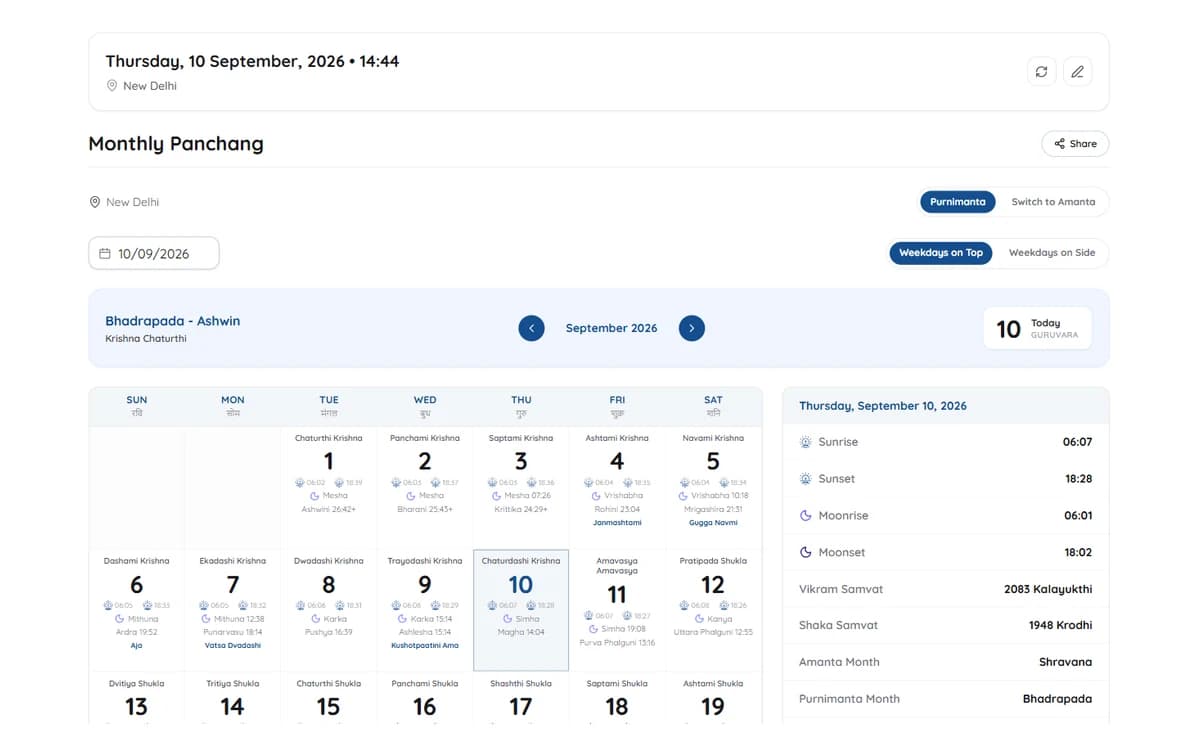
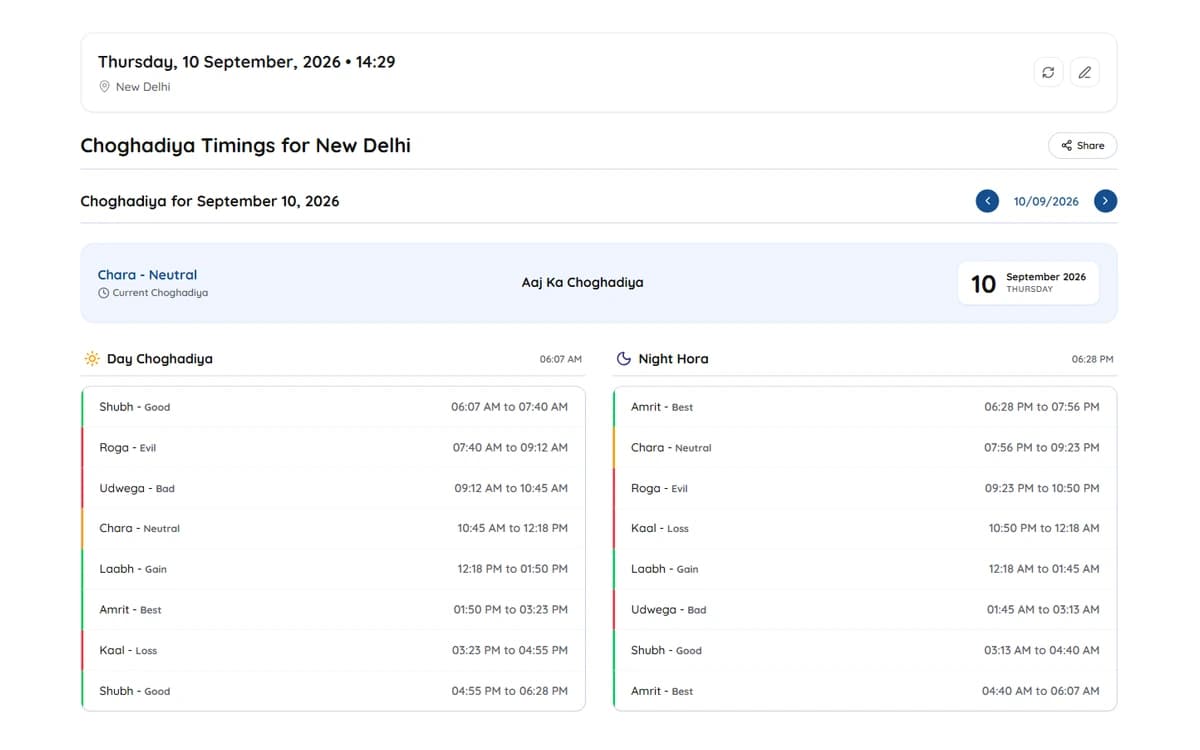
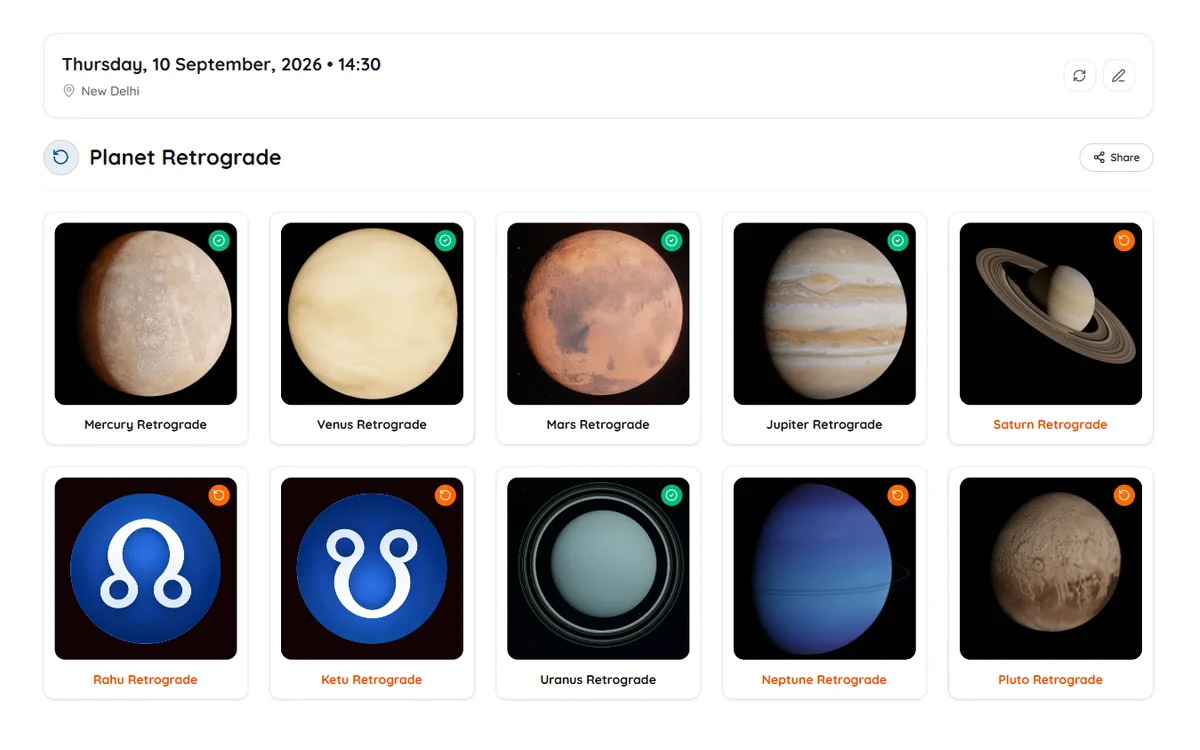
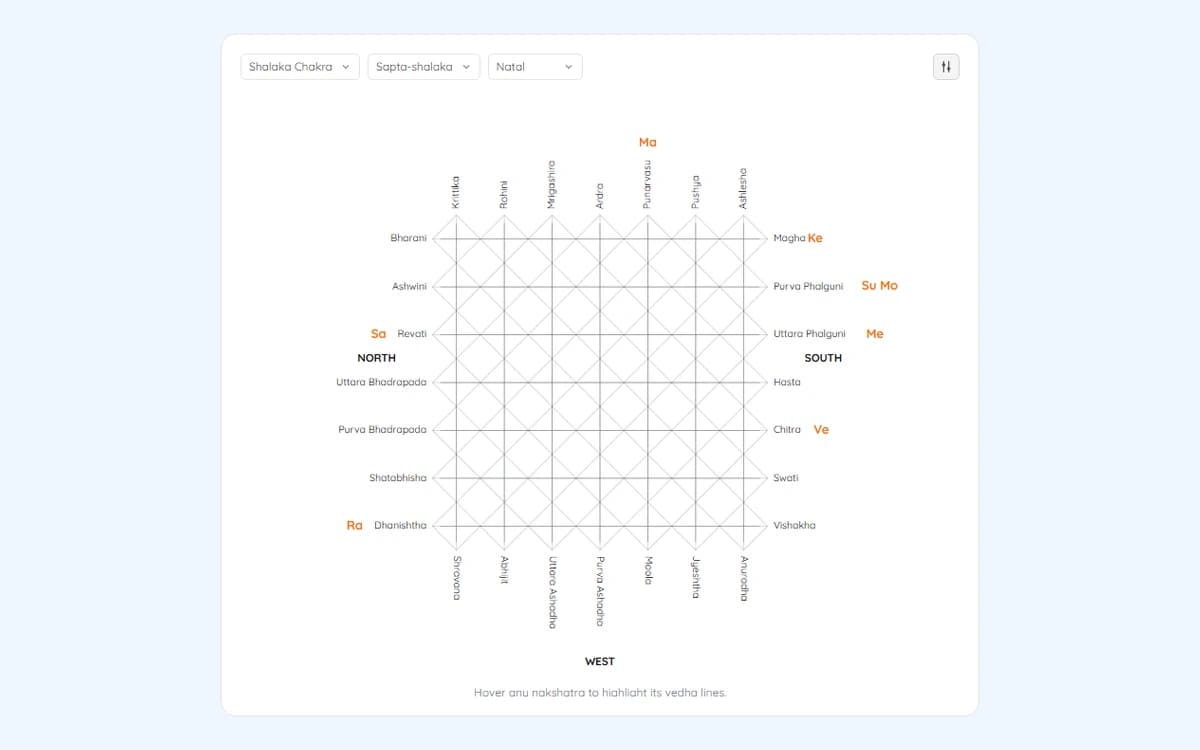
One call for the whole day, or a single endpoint for the one limb you are missing — and the same single credit either way.
Limbs, timings, calendars and festivals
Ask for all of them, pay one credit
Rahu kaal, choghadiya, hora, abhijit
One limb or all of them, same price
The whole panchang in one request
/api/astro/panchanga/ takes a date, a place and a time zone and returns up to 57 named calculations — the limbs with their exact begin and end timestamps, sunrise and sunset, the auspicious and inauspicious windows of the day, and the lunar month under both amanta and purnimanta reckoning.
Name the keys you want and leave out the rest. A request asking for one costs the same single credit as a request asking for all of them, so a daily panchang screen is one call rather than forty.
Or just the limb you need
Every limb is also its own endpoint with its own documented response — useful when you are adding one line to an existing screen rather than building a panchang page.
They all take the same request body — a date, a latitude and longitude, and a time zone — so moving between them is a change of URL and nothing else.
Timings, muhurtas and the rest of the day
Each returns real begin and end timestamps for your coordinates, not a fixed slot copied from an almanac.
- Rahu kaal
- Choghadiya
- Planetary hora
- Abhijit muhurat
- Brahma muhurat
- Amrit kaal
- Durmuhurat
- Panchak
- Tarabala
- Chandrabala
- Disha shool
- Sankranti
59 endpoints in the panchang family in all — browse them in the reference or run one in the playground before you write any code.
Eleven regional calendars, five traditions and 9,933 festival dates — each region reckoned the way it actually reckons, and still growing as regions are added.
Precomputed, one indexed query a year
Calendars, festivals, vrats and sankranti
Each its own endpoint
Hindu, Sikh, Jain, Christian, ekadashis
Eleven regional calendars, each as its own endpoint
Not one festival list with a language flag on it. Each region gets the reckoning it actually uses, returning tithi-based dates with exact begin and end timestamps for the whole year.
- Bengali
- Tamil
- Malayalam
- Telugu
- Kannada
- Marathi
- Gujarati
- Nepali
- Assamese
- Odia
- ISKCON
Alongside them: pan-Indian festivals computed from first principles for your location, eighteen vrat and upavas types, sankranti dates, samvat years and the samvatsara cabinet — eighteen endpoints in all, and still growing as regions are added.
How Occult API stacks up against the alternatives on the things a Jyotish product actually runs into.
| Feature | Occult APIRecommended | astrology-api.io | AstrologyAPI | VedicAstroAPI | VedAstro | Vedika | RoxyAPI | DivineAPI | Prokerala |
|---|---|---|---|---|---|---|---|---|---|
| Median response timeMeasured across every published example, not a marketing round number. | 62 ms | ~300 ms | Doesn’t publish it | Doesn’t publish it | <500 ms average | 200–800 ms | Doesn’t publish it | From 72 ms (best case) | Doesn’t publish it |
| Ayanamsas, hand-correctablePick a tradition, then correct it by degree, minute and second. | 48, correctable | 12, fixed list | 6, fixed list | Doesn’t publish it | ~46, fixed list | 4, fixed list | 4, or a custom value | Doesn’t publish it | 4, fixed list |
On every Occult API account
No tier, no add-on, no minimum spend. These are the defaults.
Hand-correctable to the arcsecond
Each its own endpoint
Across eleven regional calendars
Thirty named systems, drillable
No tier hides an endpoint
Plus the layout geometry
A 400 costs you nothing
Every Occult API figure is measured from the running API, and republished on each deploy. The other platforms' figures were read from their own public pricing and documentation pages between 15 September 2026 and 22 October 2026, and may have changed since. Where a cell says doesn’t publish it, that platform puts no figure on its public site — so there is nothing to compare against until you have signed up and measured it yourself. It does not mean the feature is missing, and we do not put a number there on their behalf.
We would rather you did not take this page on trust. Open one of these and the question is already written — it will search, read the public reference and the Postman collection, and report back. If we have overstated anything, that is where it shows.
Opens in a new tab with the question filled in. Nothing is sent to us.
Or skip the reading. Point an MCP-capable assistant at our MCP server and it can search the endpoints, read the request schema and make a real call — and judge the response rather than our description of it. Searching and reading the docs cost no credits.
Plans with a monthly quota, not a per-endpoint price list. Every plan calls every endpoint, and nobody has to talk to sales to raise a limit.
One credit per call, however much you ask for
A request for one calculation and a request for forty cost the same. /api/astro/panchanga/ carries 57 of them, so asking for everything you need in one call is the cheap path rather than the expensive one. The exceptions are PDF reports and AI chat, at 25 credits a call.
Failed requests are never charged
The credit is reserved before the calculation runs and released if it does not return cleanly. A 4xx, a 5xx or a timeout costs nothing — you are billed for answers, not attempts.
No seats, cancel any time
One plan covers your whole team — there is no per-developer charge. Cancel any time: the period you paid for stays usable until it ends.
Monthly or yearly plans, one credit per successful call, no seat pricing. Create a key and make your first request in the browser before you write any code.